 micro garden
Project retrospective: Offline AI bounty
Hello everyone, and welcome to my microgarden!
For those who don’t know me, I’m Ceren. Until this past January, I was building Global Communities as a part of the Base team. These days, I’m pursuing independent projects of my own, including the Garden project, while continuing to support builders and grassroots initiatives across the broader Ethereum ecosystem.
Most of my work revolves around open-source public goods, community building, and decentralized coordination. I call this little collection of experiments my microgarden, and this is the story of one of them.
A few weeks ago, a simple question turned into a bounty on POIDH: What would it take to look something up on your phone without an internet connection?
The idea was simple, but the technical challenge was anything but. Could we build an offline research assistant that runs on a phone, works without an internet connection, and delivers more than 50% of the usefulness of internet search combined with frontier AI?
Builders had a total storage limit of 50GB to work with. That meant figuring out not only how to run AI models locally, but also how to make large amounts of knowledge searchable, useful, and reliable without depending on the internet.
It was an ambitious challenge, and I was curious to see how different builders would approach it. Shout-out to Kenny, the founder of POIDH, who took the initiative to bring this bounty to life.
Explore the original bounty on POIDH
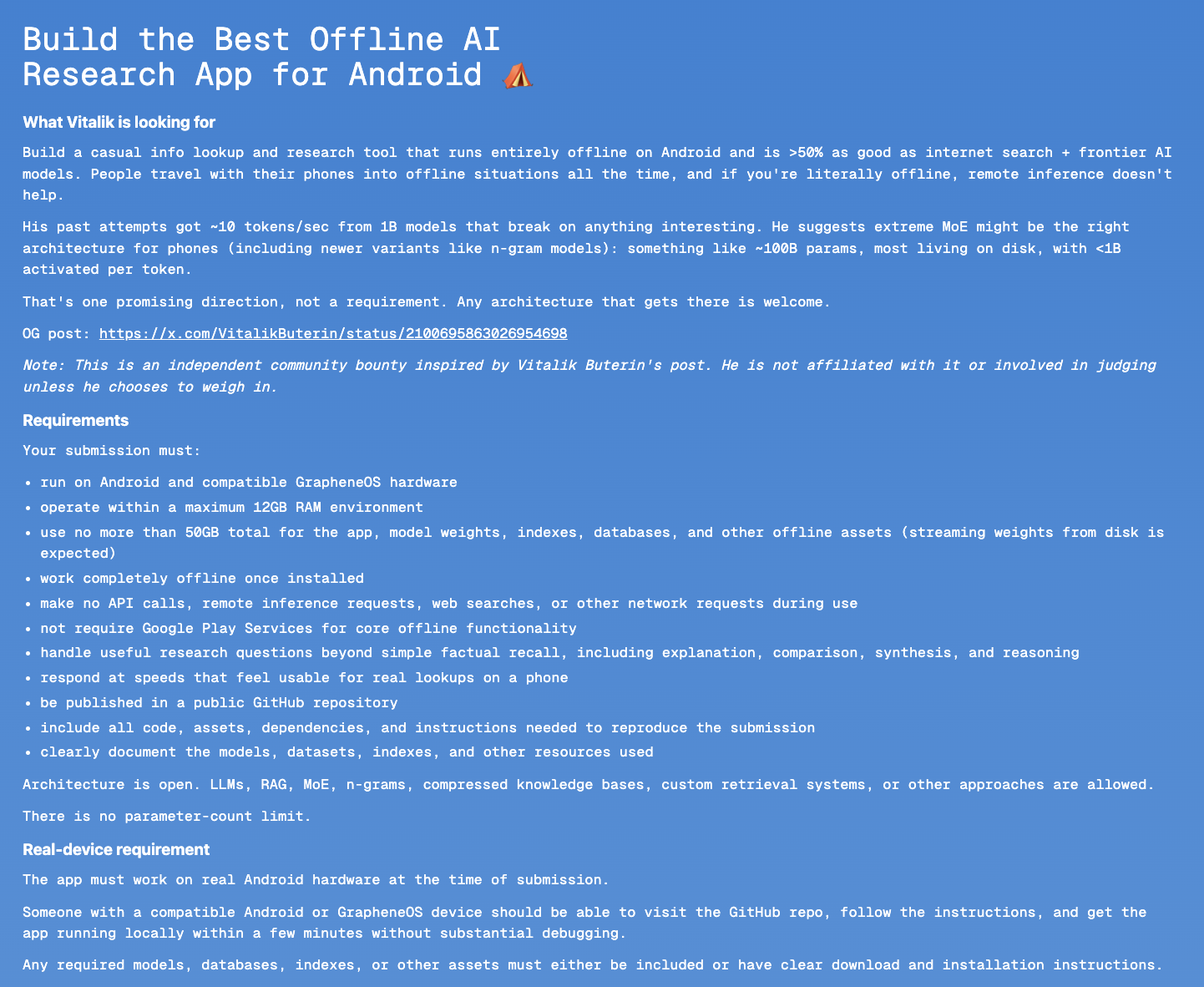
My role was mostly connecting the dots: coordinating communication between builders, contributors, and Vitalik, testing the apps, sharing feedback, and helping everyone make progress. Along the way, I ended up learning quite a bit, not only about offline AI, but also about how independent builders work together.
More than a month later, we had ten working app submissions within the designated deadline, lots of testing, plenty of feedback, and more screenshots than I care to admit!
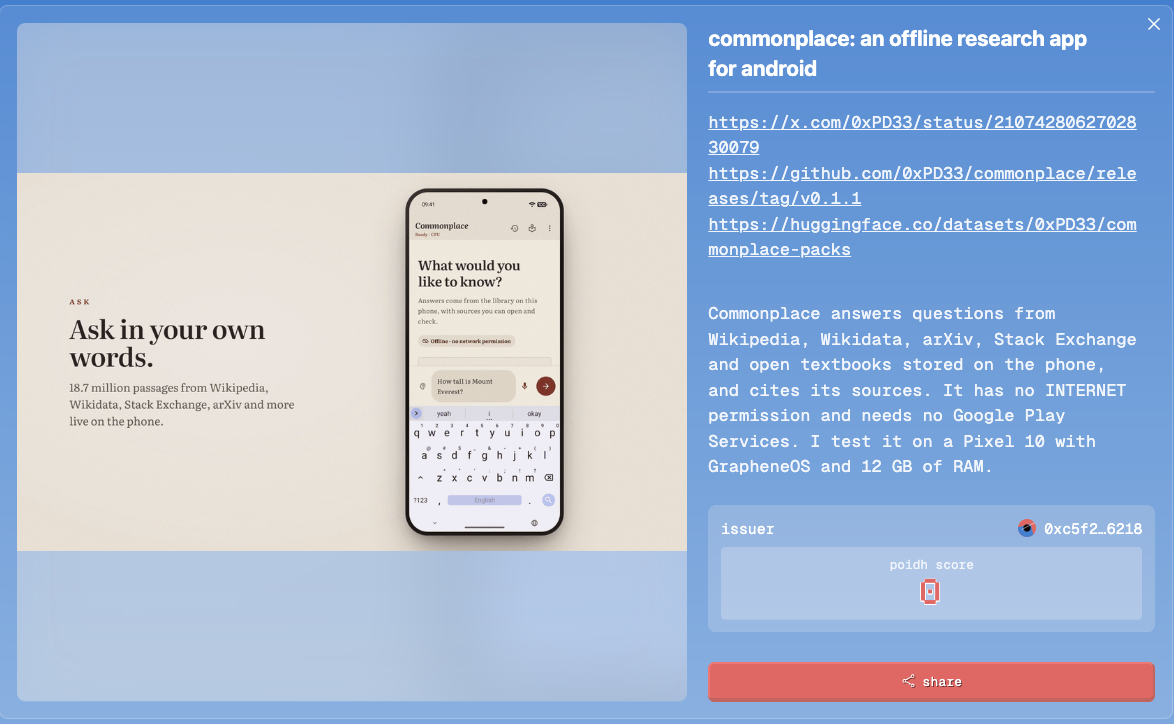
Following testing and review by bounty contributors, and a final recommendation from Vitalik Buterin, who also contributed the majority of the funding, Commonplace was selected as the winner! Congratulations to @0xPD33!
Thank you, contributors!
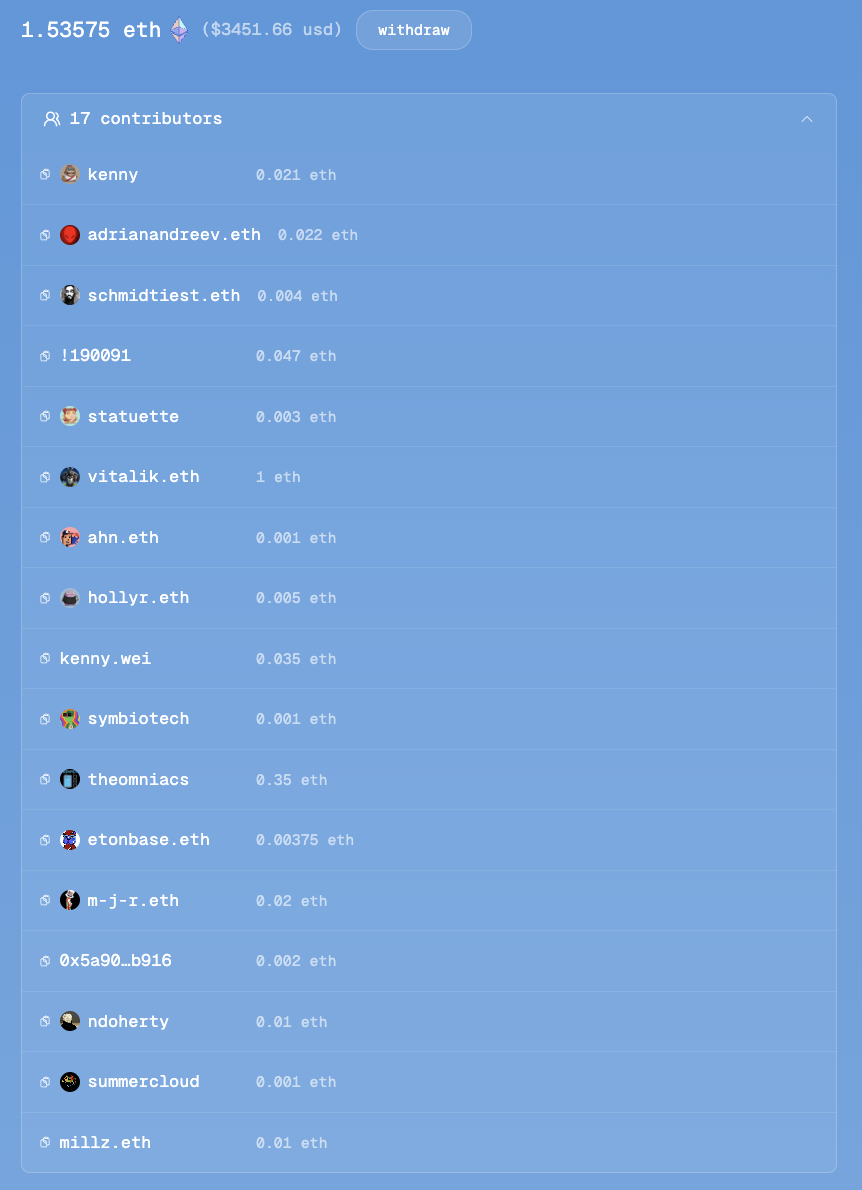
First, a huge thank you to everyone who helped fund the bounty and everyone who made time to test the submissions.
Together, we raised 1.53575 ETH to support the development of offline AI tools!
How we approached testing
We didn’t have a formal research lab or a standardized evaluation framework. What we did have was a group of curious contributors, devices, emulators, and builders who were willing to keep improving their work. It’s important to distinguish this from a controlled benchmark. We didn’t systematically measure whether the submissions reached the bounty’s ambitious 50% usefulness target.
The bounty contributors, Kenny, and I tested the apps independently, paying attention to practical things like installation, offline functionality, the usefulness of their knowledge libraries, the quality of their answers, and how well they handled follow-up questions.
We also shared feedback with builders throughout the process, giving them opportunities to identify problems and make improvements.
The contributors’ testing and observations helped inform the review, while Vitalik, as the majority contributor, provided the final recommendation.
What we did get was a valuable picture of what these tools could already do, where they struggled, and what might make them more useful in everyday situations.
The bounty has a winner now, but I hope the learning, relationships, and open-source work continue to grow beyond it.
Thank you, builders!
A big thank you to every builder who participated, shipped something, responded to feedback, and kept improving. We received ten independent submissions by the deadline, each approaching the same challenge from a different direction.
Some focused on local document retrieval, others on general-purpose offline knowledge, travel information, or making smaller models more useful on mobile devices.
I particularly appreciated seeing how quickly some of the projects evolved as builders received feedback and learned from one another.
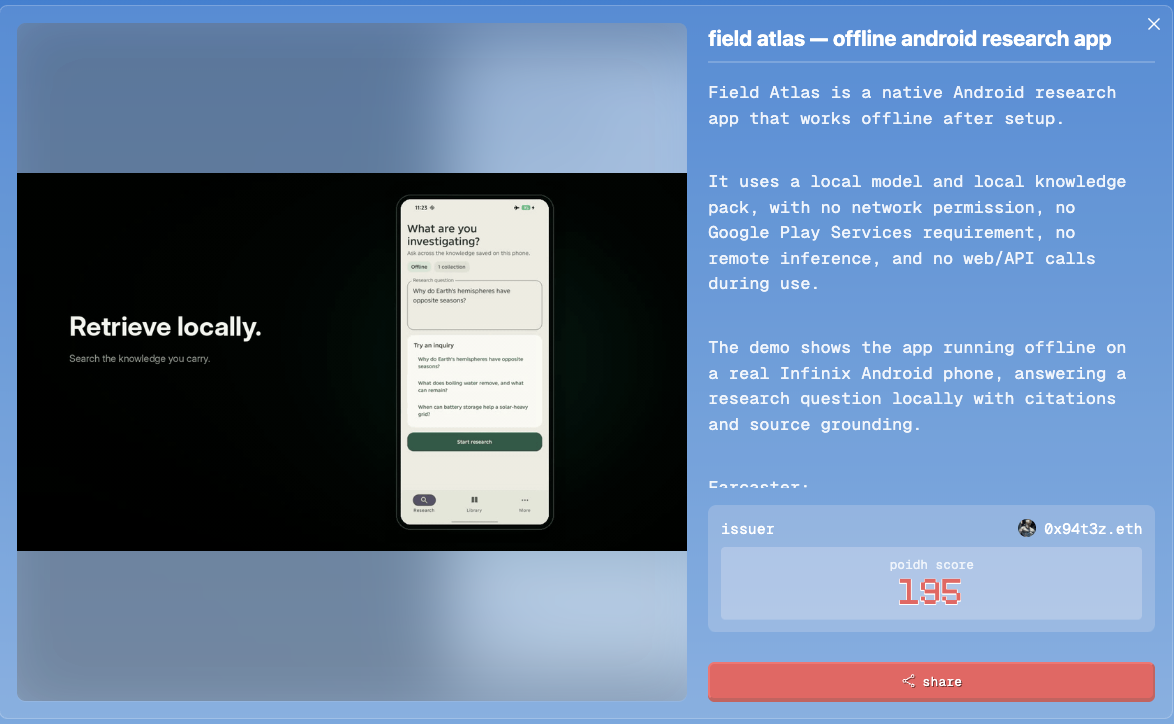
Here are all ten submissions.
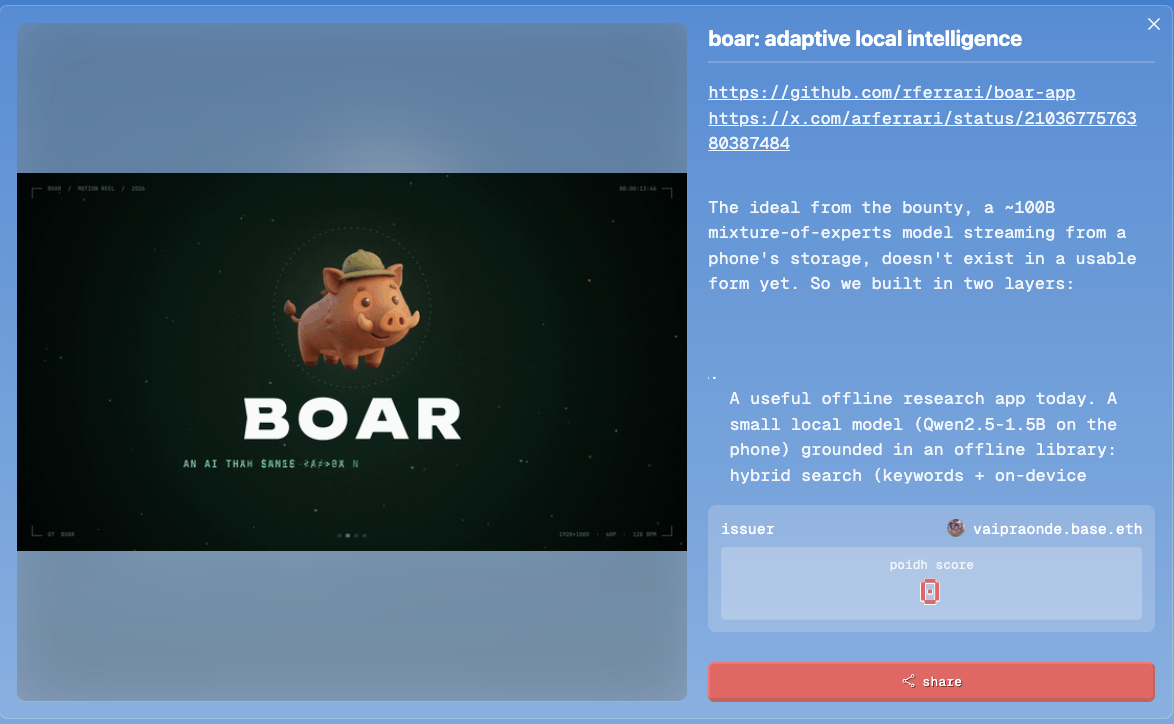
Field Atlas / BOAR
Explore Field Atlas | Explore BOAR
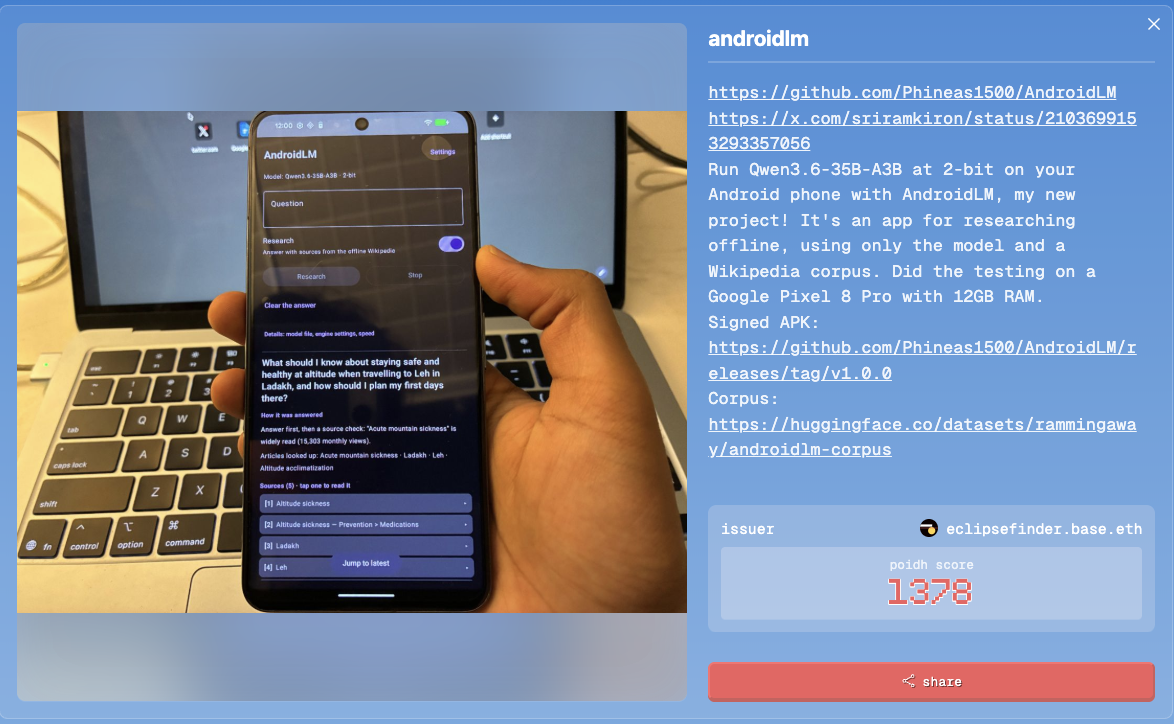
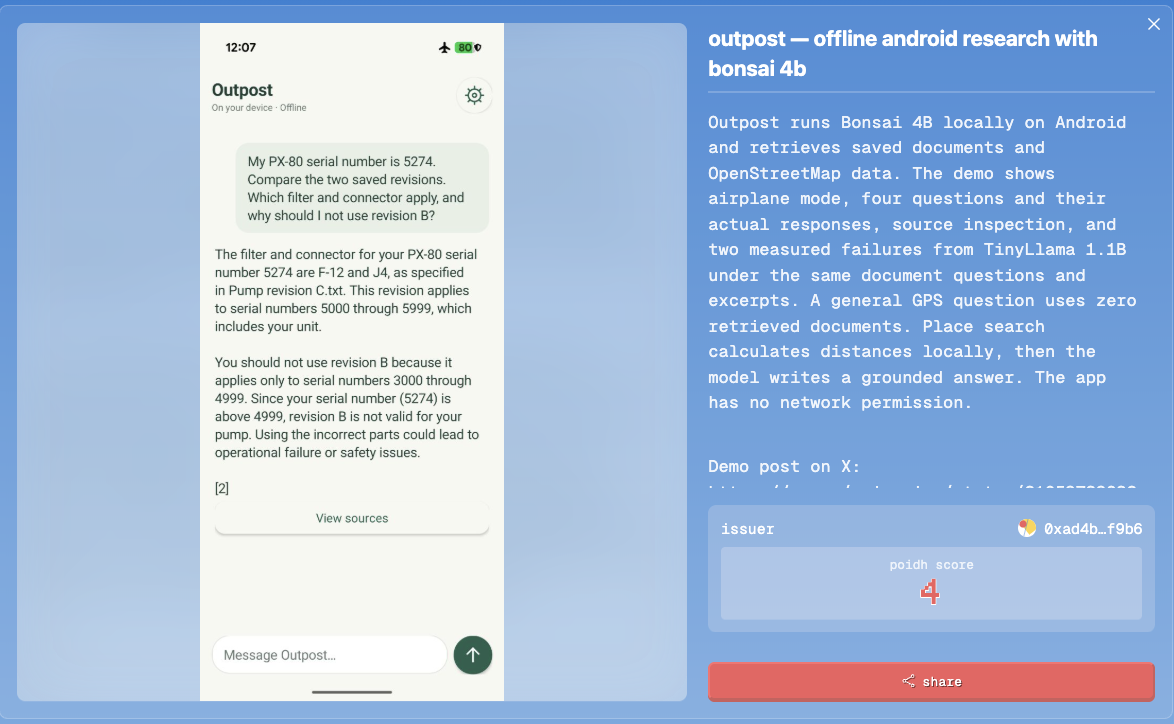
AndroidLM / Outpost
Explore AndroidLM | Explore Outpost
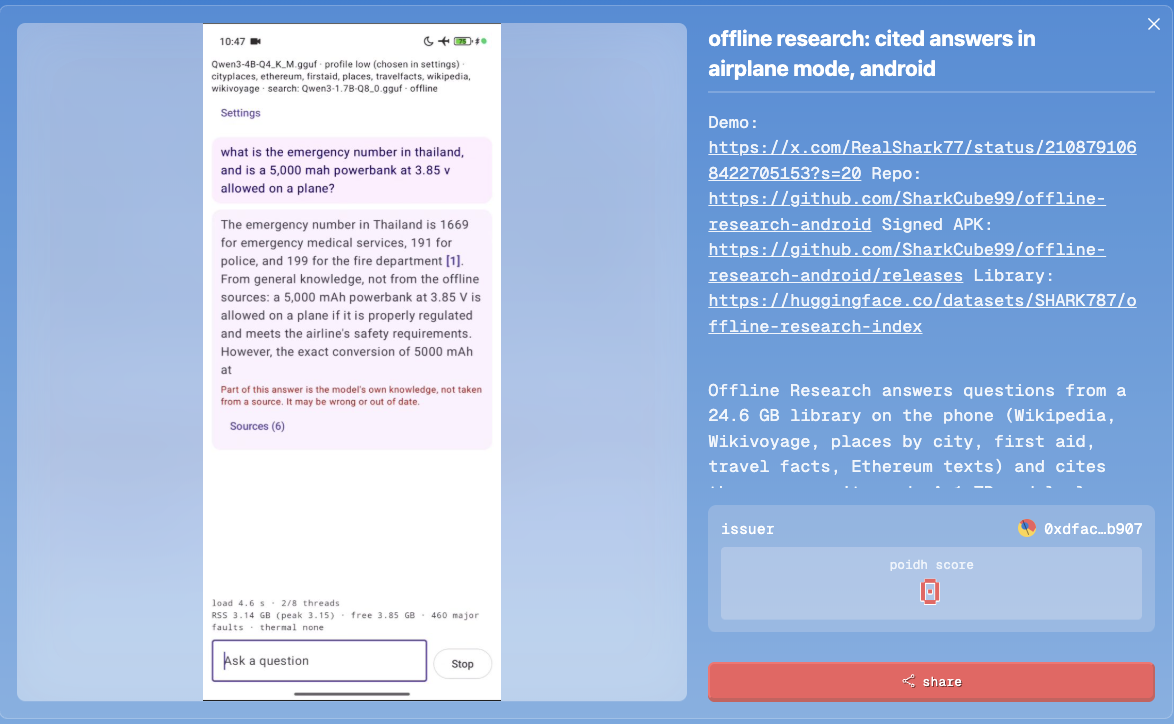
Commonplace (Winner) / Offline Research
Explore Commonplace | Explore Offline Research
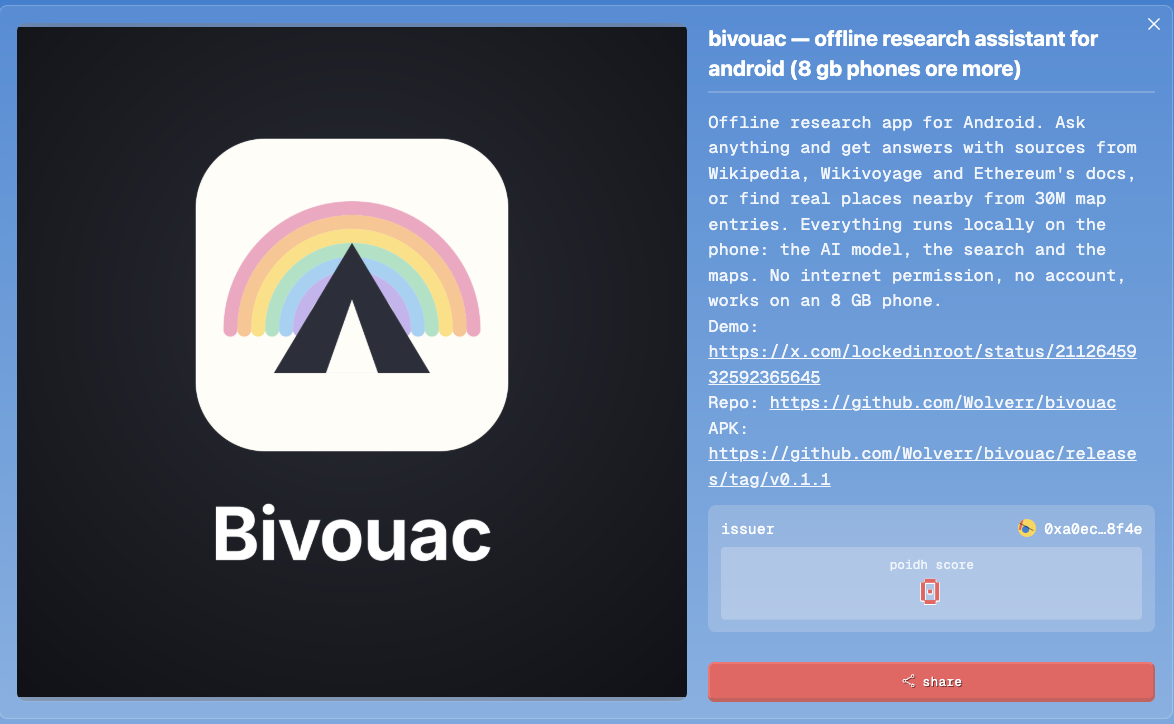
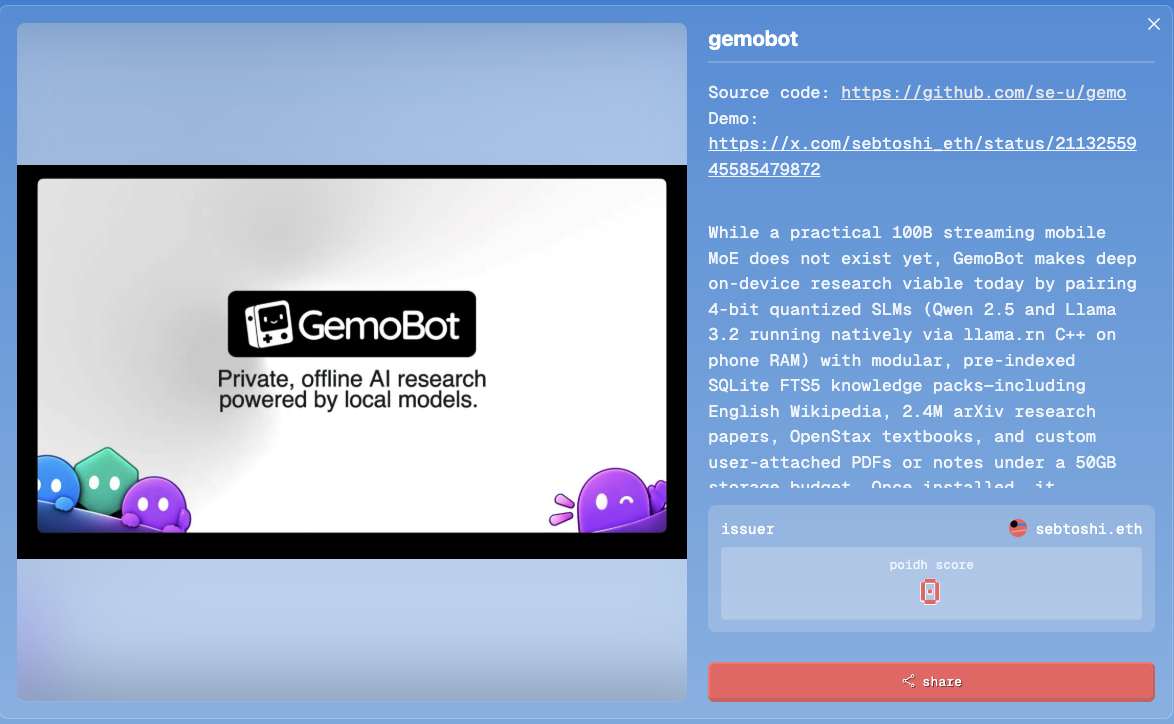
Bivouac / Gemobot
Explore Bivouac | Explore Gemobot
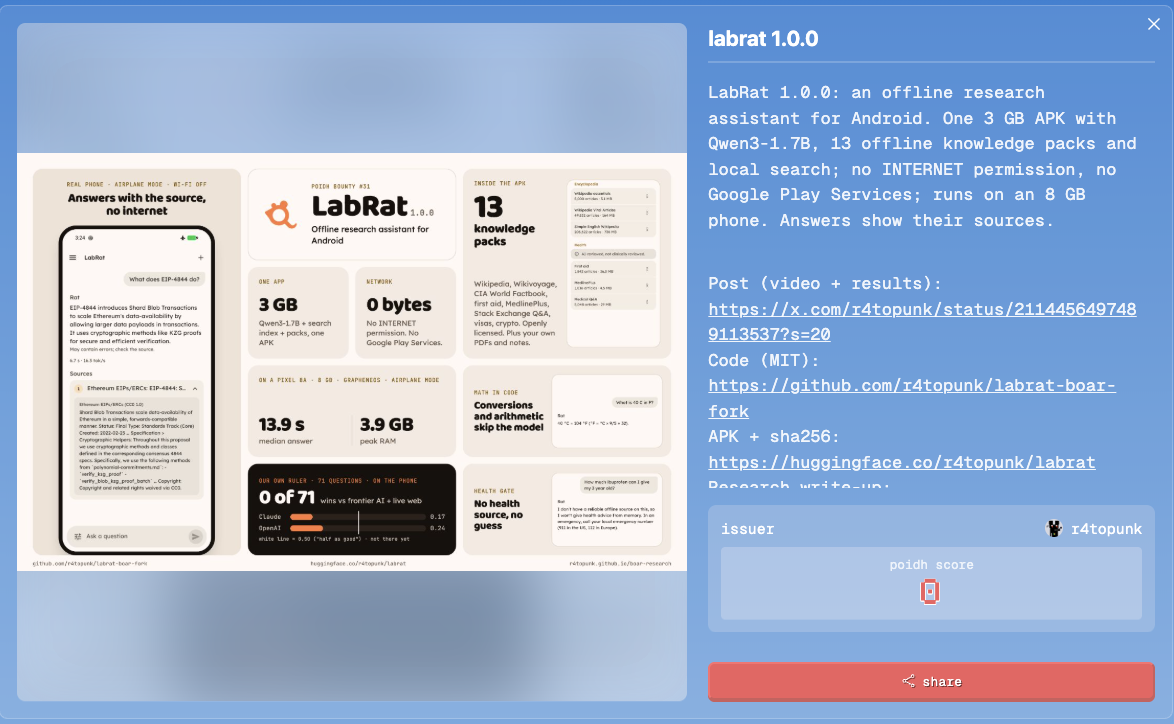
Pocket Scholar / LabRat (BOAR fork)
Explore Pocket Scholar | Explore LabRat
What we learned
One of the most interesting things about testing these apps was discovering how easily an answer could look convincing while still being wrong. An app might retrieve the correct document, reference the right passage, and present a nicely sourced answer, only to make a mistake in its reasoning. Arithmetic questions and follow-up prompts were particularly revealing.
It became clear to me that finding the right information and reasoning correctly about that information are two different problems. And solving one doesn’t automatically solve the other.
I also started appreciating something much simpler: sometimes the most useful thing an AI assistant can do is find the right document and let you read it. Not everything needs an elaborate generated response.
Vitalik’s feedback throughout the bounty was especially helpful in keeping everyone focused on practical usefulness.
He encouraged builders to think beyond a handful of successful prompts and consider everyday situations: installing the app, finding useful travel information, accessing a much broader knowledge base, and getting reliable answers across different questions.
He also pushed for making better use of the available storage. With a 50GB total limit, there was room to explore significantly larger offline knowledge libraries.
Why Commonplace stood out
One feature we particularly appreciated about Commonplace was its approach to presenting information. Instead of making users wait for the AI to finish generating a response, Commonplace displayed a basic search result immediately, followed by the generated answer.
It’s a relatively simple design decision, but a useful one. People can start reading relevant information while the model continues working.
Vitalik also mentioned that Field Atlas had been quite useful to him personally, particularly for its travel-related information. Given how much he travels, I can see why!
Both observations made me think about the importance of designing around what people actually need, rather than just demonstrating what a model can do. I’d love to see more experimentation with personal offline knowledge libraries that people can assemble around their own needs.
Imagine preparing for a trip by downloading local information, maps, guides, documents, and useful references, then being able to explore all of it without an internet connection. Or doing the same for research, education, and other areas where having reliable information matters.
There’s so much room to build here!
On Sanctuary tech
When I read Vitalik’s blog post on digital minimalism yesterday, I kept thinking about the relationship between digital wellness and technological sovereignty.
For many of us, being online is something we take for granted. We have reliable internet connections, access to powerful AI tools, and the freedom to disconnect whenever we want. But not everyone has that luxury.
People living through economic hardship, conflict, censorship, or unreliable infrastructure may not have consistent access to the internet, let alone frontier AI services. And even for those who do, being constantly connected comes with its own costs.
This is where I think sanctuary tech becomes interesting.
I see sanctuary tech as technology that creates a little breathing room for humans. Tools that help us preserve our attention, privacy, agency, and independence, while remaining useful when the systems we normally rely on become unavailable.
An offline research assistant is a great example.
Imagine being able to carry a useful library of knowledge in your pocket, search it, ask questions, and find information without relying on a server somewhere else. For some people, that’s a matter of convenience or digital wellness. For others living in unstable political or economic environments, it could be much more consequential.
What I like about this approach is that it doesn’t force us to choose between useful technology and technological independence.
We should be able to have both.
Could innovation compound through pluralism?
Now for my favorite part of this experiment.
Alongside the technical testing, I was curious about something I’ve been thinking about for a long time: Can independent builders cooperate toward a shared goal without giving up the differences that make their work valuable?
I shared a hypothesis with Vitalik:
“Freely chosen cooperation among independent builders can advance a shared purpose and improve collective outcomes while preserving the differences that give rise to innovation.”
The bounty created an interesting environment to explore this. On one hand, the builders were competing for the same prize. On the other, they were all trying to solve a difficult technical problem, and each had something to learn from the others.
Would someone share a useful discovery with a competitor, even knowing that it might improve the competitor’s chances?
Could the longer-term value of learning, relationships, reputation, and a stronger ecosystem outweigh the short-term incentive to keep everything to themselves?
I was curious to find out.
A scrappy coordination experiment
I spend a lot of time thinking about coordination systems, incentives, and governance. But sometimes the most important part of coordination is much simpler: making sure people understand why they’re in the same room, what they’re being asked to do, and what they’re free not to do.
I invited the builders into a voluntary group chat, hoping to create a space where they could exchange ideas, ask questions, and potentially collaborate. What interested me was whether cooperation would emerge naturally once people had a shared space and enough clarity to make their own decisions.
We set up some important boundaries. Everyone remained independent and retained ownership of their own submissions. Joining the chat didn’t give anyone permission to use another builder’s unpublished work. Sharing was voluntary, licenses and attribution still mattered, and participation had no bearing on judging.
There was understandable hesitation at first. After all, these were people competing for the same funding. But once the boundaries became clearer, I started seeing some encouraging interactions.
A few builders exchanged information, others got to know people working on similar problems, and some began exploring ways to build on shared research. One thing that stood out to me was how important trust and expectations were. Some chose to share more than others, and that was perfectly fine.
The goal wasn’t to make everyone collaborate. It was to make collaboration possible.
That’s a distinction I want to preserve in future experiments. I didn’t have time to turn this into a proper research study, so I can’t claim the experiment proved my hypothesis. Still, there were some interesting signals.
The BOAR team deserves a special shout-out here.
The team openly shared its research and development process and encouraged a teammate to fork the project and submit an independent version called LabRat.
I loved seeing that!
Instead of treating the creation of another submission as a threat, they treated their work as something others could build upon. The original work remained credited, the new builder had room to experiment independently, and the shared research became more useful because it could be tested through another approach.
That, to me, is one of the most valuable things about open-source development.
And the story didn’t stop with the bounty. @r4topunk went on to launch a new bounty, Audit a Month of Offline AI Research, inviting others to challenge the findings, identify mistakes, and suggest improvements supported by evidence.
Their public research record includes hundreds of experiments, including roughly 400 unsuccessful ones. I find that particularly valuable.
We tend to celebrate successful results, but there’s an enormous amount of knowledge in understanding what didn’t work and why. A failed experiment that is properly documented can save another builder weeks of effort. And inviting others to challenge your findings takes that openness a step further. It turns research into something people can collectively examine, improve, and build upon.
I have a lot of respect for that experimental spirit.
What I’d do differently next time
Looking back, there are a few things I’d approach differently.
First, I’d establish a shared testing framework earlier. We learned quite a bit from testing independently, but having a common set of questions, devices, and evaluation criteria would have made it easier to compare observations and understand where the differences came from.
I’d also document the testing process more consistently. A lot of useful feedback happened through conversations, screenshots, and individual testing sessions. Capturing those observations in a shared, structured format could create a valuable public resource for future builders.
And I’d love to experiment with ways to recognize contributions beyond the winning submission.
A bounty naturally creates a competition around a prize, but there’s a lot of valuable work that doesn’t necessarily end up winning. Research, testing, documentation, useful failures, and discoveries that other builders can build upon all contribute to progress.
What if we could recognize and reward some of those contributions without making the coordination process unnecessarily complicated?
I’m particularly interested in exploring a more pluralistic model for future bounties, where different kinds of contributors can participate in the same coordination process. We could even use this as a reference point and compare what happens when we introduce more deliberate opportunities for collaboration.
I don’t think we proved anything revolutionary about cooperation or pluralism. That wasn’t the purpose of the bounty, and we didn’t design it as a controlled experiment. But we did observe some promising behaviors worth studying further. I’m curious to see what happens when we design the next experiment more deliberately.
More seeds to plant
I’ve spent much of my career helping communities and builders connect, grow, and work toward shared goals. Although I started this project thinking mostly about offline AI and sanctuary tech, by the end, I found myself drawn once again to what it revealed about human coordination.
One thing I keep coming back to is that communities don’t grow simply because we put people in the same space. They grow when people have reasons to participate, opportunities to contribute, and enough trust and freedom to find their own ways of working together.
I don’t have all the answers, but I’m enjoying asking questions, running small experiments, and learning alongside the people who are building. And that’s exactly what I plan to keep doing in my microgarden.
Thanks again to all the contributors, testers, and especially the builders who made this possible.
I enjoyed this little experiment, and I’m glad we planted quite a few seeds.
Let’s see what grows next!